
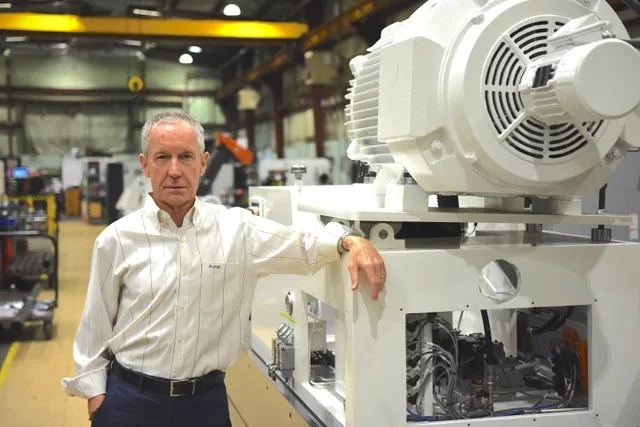
Stanley Wright has worked in manufacturing management since 1998. His career has run through a Fortune 500 industrial conglomerate, an aerospace composites buyout he led himself, and since 2018, Sierra Machinery & Engineering in Sparks, Nevada.
The thread running through all three is operational: taking manufacturing businesses and making the way they run repeatable.
A Decade at Illinois Tool Works
Wright spent ten years at Illinois Tool Works, the Fortune 500 diversified manufacturer headquartered in Glenview, Illinois. ITW operates through hundreds of businesses across dozens of countries, organized into separate operating units rather than a single centralized structure.
He held a range of positions across several of those business units. Two of them sat in demanding technical markets: electronics repair, and consumables for semiconductor manufacturing. Semiconductor supply chains hold suppliers to narrow tolerances and documented process control, and electronics repair work depends on diagnostic discipline and turnaround.
Moving between business units inside a decentralized manufacturer is a particular kind of training. Each unit has its own customers, margins, and operating problems, and the skill being built is reading a business quickly and finding where its process actually breaks.
Leading the Ultracor Buyout
In 2008, Wright led the buyout of Ultracor, an aerospace composites manufacturer, and spent the next decade running it.
Aerospace composites is an unforgiving sector to own. Qualification cycles are long, customer audits are routine, traceability requirements are strict, and documentation carries the same weight as the part itself. A supplier in that market either has systems that hold up to inspection or it does not stay a supplier.
Leading a buyout is also a different job from managing a division. The operator carries the capital structure, the customer relationships, and the consequences of every operational decision at the same time.
Sierra Machinery & Engineering, 2018 Onward
In 2018, Wright participated in the acquisition of Sierra Machinery & Engineering, a manufacturer of skiving and roller burnishing machines and the tooling that runs on them, based at 1651 Glendale Avenue in Sparks, Nevada.
Sierra has been building these machines since 1979. The company runs a 22,000 square foot facility with a 26-person team, and its machines are in operation across North and South America, Europe, India, Japan, China, Korea, and Australia. One customer’s machine, bought in 1992, remains on their production floor.
That history presented a specific challenge. A company with decades of accumulated knowledge often holds that knowledge in people rather than in documented process, which is durable until the people retire.
Building the Platform
Since joining, Wright’s work has centered on routinizing processes and systematizing product quality, with the aim of giving the company a stable platform for growth.
In practice that work shows up in what Sierra now publishes about how it operates. Every part is measured, inspected, and verified in the company’s CMM Lab before it ships, backed by a full quality management system. Tooling is designed and produced in house across more than 200 sizes from 38mm to 508mm. New machines carry a 12 month warranty, and the company offers remote support from Sparks.
Those are the visible outputs of process work. The underlying change is that quality becomes a system rather than an outcome that depends on who happens to be running the job.
Product Development and the Market
More recently, Wright has started several product development and marketing initiatives aimed at opportunities in the metalworking marketplace.
Sierra’s position makes that a reasonable place to push. The company designs and builds both the machine and the tooling, operates a full precision shop covering CNC machining, tooling and molds, and welding and fabrication, and publishes performance figures for its equipment that buyers can evaluate directly: one forward pass, 17 seconds, on an 80mm ID tube at 1 meter with 2mm of stock removal.
The work ahead is making sure the buyers who need that capability know it exists. Part of that is published writing on bore finishing, machine selection, and precision manufacturing, which appears on the Sierra Machinery blog.
Get in Touch
Stanley Wright works from Sierra Machinery & Engineering’s facility at 1651 Glendale Avenue in Sparks, Nevada. To discuss a bore finishing application, a machine evaluation, or a contract manufacturing job, contact the team with the tube size, length, and material.