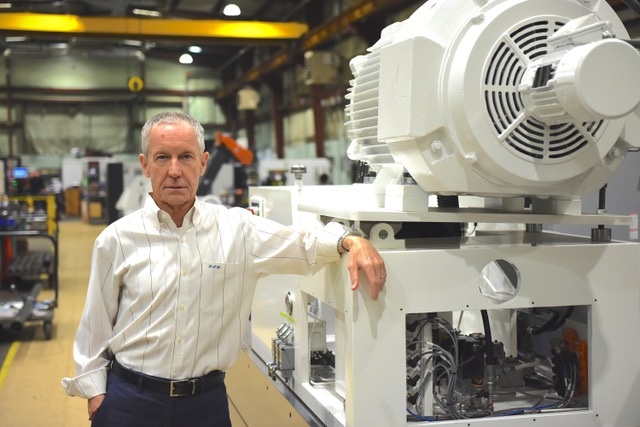
By Stanley Wright, President, Sierra Machinery & Engineering
Are Manufacturing Trade Shows Still Worth Exhibiting At?
Manufacturing trade shows remain a viable marketing activity, particularly for reaching buyers who never encounter a company through search or social media. After exhibiting at four shows across the past year, including IMTS 2026 and FABTECH 2026, I came away with database contacts, actionable leads, and a clear sense of how to exhibit more effectively next time.
With the proliferation of marketing technology solutions in recent years, one prevailing train of thought has been that the trade show will become a less useful tool or perhaps even obsolete. When I succeeded Sierra Machinery’s founding owner, she gave me that exact view. She had ceased exhibiting at trade shows because she viewed them as less effective.
Sierra Machinery & Engineering builds Skiving and Roller Burnishing machines and tooling in Sparks, Nevada, and runs a full precision shop covering CNC machining, tooling and molds, and welding and fabrication. What follows is my own account of a year spent testing that inherited assumption on the floor.
The Pandemic Years and a Slow Recovery
A year and a half after I joined Sierra Machinery, the pandemic struck, obliterating trade show activity for a year and stunting its recovery. Lockdowns, travel restrictions, and health mandates caused widespread event cancellations in 2020 and a slow, cautious restart through 2021.
As live events returned, attendance trailed pre-pandemic baselines for several years. The Center for Exhibition Industry Research, now the research division of the International Association of Exhibitions and Events, tracks this through its CEIR Index. Its 2024 Index Report, published in April 2024, found that 2023 industry performance still trailed 2019 by 11.0 percent, after a 19.6 percent year-over-year gain.
Attendance has been the slowest of the Index’s four metrics to come back. In the fourth quarter of 2024, attendance was still 12.9 percent below the same quarter in 2019, even as exhibitor counts had returned to within 0.1 percent of pre-pandemic levels.
Corporate budget tightening, workforce shifts such as retirements among older demographics, and lingering travel caution also contributed to smaller crowd sizes. While the trade show business has recovered considerably since then, attendee numbers still trail marginally behind where they were in 2019.
That is the backdrop against which I decided to start exhibiting again.
Testing the Waters at Regional Shows
In September 2025 I attended FABTECH in Chicago and was favorably impressed by the floor traffic to resume exhibiting at trade shows.
In the past year Sierra Machinery exhibited at two Design-2-Part shows. Design-2-Part is a national company which hosts a number of regional two-day shows dedicated to job shops. The two-day format and the comparatively short trade show day serve to focus the attendee activity in a way that balances time and opportunity. Design-2-Part also emphasizes keeping the costs down, often renting space advantageously in order to cater to small businesses.
We exhibited at the Oaks, Pennsylvania Design-2-Part show, which you can think of as Philadelphia, and also the Denver show. The Oaks show, while seemingly far from the industrial spaces of Philly, was well attended, and we received a good number of actionable leads. The show in Denver, which has less of a metalworking industrial base than does the East Coast, was less useful, though we still received several decent leads.
The lesson there is one every regional exhibitor learns eventually. Geography is not incidental. A show’s value tracks the density of the industrial base around it, and two shows run by the same organizer in the same format can produce markedly different results.
IMTS 2026: Scale, and the Problem of Being Small
The focus of this year was the fall and two massive trade shows. The first was IMTS, the International Manufacturing Technology Show, held biennially at McCormick Place in Chicago and owned and produced by AMT, The Association For Manufacturing Technology.
According to the show, “IMTS 2026 brought together over 90,000 attendees, over 1.17 million square feet of exhibit space and more than 1,700 exhibitors offering manufacturing technology solutions.” AMT’s final figures put the count at 91,295 registrants, including 14,447 students, across 1,788 exhibiting companies, an increase of about 2.6 percent in registrants over 2024.
The scale of the show was remarkable, four halls full of exhibits, dominated by major industry machine manufacturers like Mazak, Haas and others and also by technology players like Hexagon, the metrology company, which had booths in two halls.
At such a show, smaller companies risk getting lost in the vastness. Companies taking 100 square foot spaces need a tight marketing message, advanced planning and a great ground game.
Just two booths down from me was a company with an inexpensive machine for making shims. Their demo equipment kept potential customers engaged. It was the most effective small booth I saw at the show, and the reason was not budget. It was that something was running, and a running machine gives a passer-by a reason to stop walking.
While I made some good contacts at the show, I also learned a good deal about how to do it better next time.
FABTECH 2026 and the Job Shop Pavilion
With Sierra Machinery’s focus on broadening its product and service line, we also attended FABTECH 2026 in Las Vegas, held October 21 to 23 at the Las Vegas Convention Center. FABTECH is a show focused on the sheet metalworking industry. Think laser cutting and press brake. Machine manufacturers like Trumpf and Mitsubishi Laser.
The show occupied 727,251 square feet, attracted 32,530 industry participants and 1,461 exhibitors, which organizers reported as the event’s largest attendance outside Chicago in its return to Las Vegas after a decade. Notable to me: 59 percent of attendees were at FABTECH for the first time. So while comparable to IMTS in exhibitors, attendees were roughly a third.
One interesting thing that FABTECH initiated in its Chicago 2025 show was a job shop pavilion, a concentrated area in which jobbers could exhibit their trade and discover new clients. This was a clever way for FABTECH to sell more exhibit space that proved successful in Chicago 2025 and was rolled into Las Vegas for 2026.
It was in this area of the show that Sierra Machinery exhibited as we look to explore new opportunities for our various talents: machining, weld, assembly and motion control.
I must say that while this show did not have the foot traffic of IMTS, the job shop pavilion visitors looking specifically to round out their supply base impressed me, as I came away with many good connections.
That contrast is the most useful thing I learned all year. A smaller show where every attendee is looking for what you sell will beat a larger show where almost nobody is.
What I Would Tell Another Small Manufacturer
Four things, drawn from a year of doing this.
- Match the show to the buyer, not to the headline number. The job shop pavilion at a 32,500-person show produced better conversations for our contract work than four halls at a 91,000-person show.
- Give people a reason to stop. The shim machine two booths down outperformed exhibits that cost many times more, because something was running.
- Treat the regional shows as a cheap experiment. Design-2-Part shows cost less and taught us where our regional demand actually sits.
- Plan the follow-up before the show, not after. The contacts are the asset. What you do with them in the months afterward is the return.
The Verdict
My path through the past year’s trade shows convinces me that they remain a viable marketing activity, especially for reaching customers that might never get pinged by one’s SEO platform or social media campaigns. That said, newer technologies probably offer more bang for the buck and should enjoy more of the marketing budget.
There is something to be said for the face-to-face introduction, for making the personal connection from the start.
I end my trade show year with new database contacts that I can access in the months and years to come. Relative to the money spent to acquire them, I believe the payoff will be substantial. Also substantial is the learning I can use to employ trade show activities more effectively next year.
Frequently Asked Questions About Manufacturing Trade Shows
01Are manufacturing trade shows still worth the investment?
They remain a viable marketing activity, particularly for reaching buyers who would never find a company through search or social media. Newer marketing channels often deliver more measurable return per dollar, so trade shows work best as one part of a budget rather than the whole of it.
02How large was IMTS 2026?
AMT, which owns and produces the biennial show, reported 91,295 registrants at McCormick Place in Chicago from September 14 to 19, 2026, including 14,447 students. The show featured 1,788 exhibiting companies across 1.17 million square feet of exhibit space, up about 2.6 percent in registrants over 2024.
03How did FABTECH 2026 compare to IMTS 2026?
FABTECH 2026 ran October 21 to 23 at the Las Vegas Convention Center with 32,530 participants, 1,461 exhibitors, and 727,251 square feet. Exhibitor counts were broadly comparable to IMTS, while attendance was roughly a third, and 59 percent of attendees were new to FABTECH.
04What is a job shop pavilion at a trade show?
It is a concentrated area of the floor where contract manufacturers exhibit their capabilities to buyers looking to add suppliers. FABTECH introduced one in Chicago in 2025 and brought it to Las Vegas in 2026. Traffic may be lower than the main floor, with visitors arriving for a specific reason.
05Has trade show attendance recovered to pre-pandemic levels?
Not fully. The CEIR Index found 2023 industry performance trailing 2019 by 11.0 percent, and attendance has been the slowest of its four metrics to recover, still 12.9 percent below 2019 in the fourth quarter of 2024, even as exhibitor counts returned to pre-pandemic levels.
Sierra Machinery & Engineering: Machines and Parts from Sparks, Nevada
Sierra Machinery & Engineering has built skiving and roller burnishing machines in Sparks, Nevada for 47 years as of 2026. A 26-person team runs a 22,000 square foot shop, with every part verified in our CMM Lab before it ships.
What We Build:
- Skiving & Roller Burnishing Machines: One forward pass, 17 seconds, on an 80mm ID tube at 1 meter with 2mm stock removal. CE certified.
- Contract Manufacturing Services: CNC machining, tooling and molds, and welding and fabrication, all in house
Did we meet at a show this year, or should we have? Request a quote and tell us what you are trying to build.
Works Cited
- Center for Exhibition Industry Research. “CEIR Exhibition Index.” International Association of Exhibitions and Events, 2026, www.iaee.com/ceir/exhibition-index/.