Roller burnishing vs honing is the question cylinder manufacturers actually argue about, and boring sits underneath both of them as the operation that often comes first. The three are not interchangeable, and none of them is the right answer in every plant.
Sierra Machinery & Engineering builds Skiving and Roller Burnishing machines and tooling in Sparks, Nevada, and runs a full precision shop covering CNC machining, tooling and molds, and welding and fabrication. This comparison looks at the three processes on the terms that decide production decisions.
First, Agree on What You Are Measuring
Most bore finishing arguments go wrong before they start, because the two sides are comparing different quantities.
Surface texture has an internationally agreed vocabulary. ISO 21920-2:2021, published in December 2021 by ISO technical committee 213, specifies the terms, definitions, and parameters for determining surface texture by profile methods. It replaced ISO 4287:1997 along with several other profile standards that had been in use for decades.
That matters because roughness average is one parameter among many, and the standard defines others that describe the shape of the profile rather than its average height. A cut surface, an abraded surface, and a burnished surface can report similar average roughness and have profiles that look nothing alike under a seal.
Before comparing processes, confirm which parameter the drawing specifies and which one the receiving inspection measures. Comparisons made on different parameters are not comparisons.
How Each Process Removes and Finishes
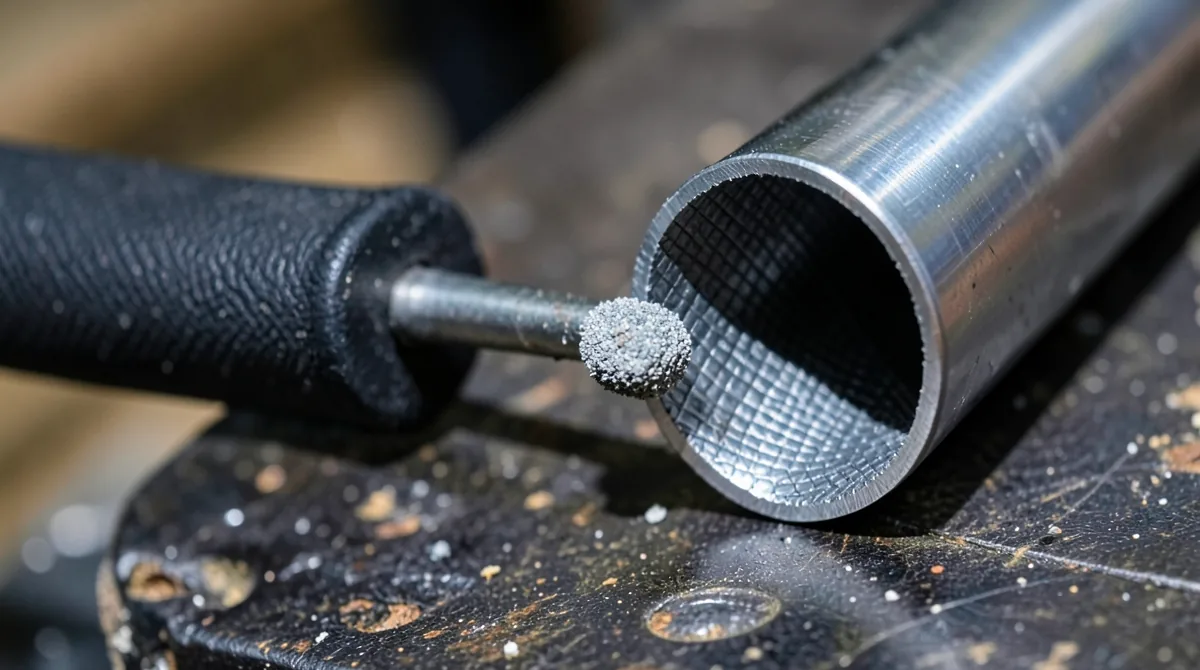
Boring cuts the bore to diameter with a single-point or multi-point tool. It is accurate, it handles heavy stock removal, and it leaves a cut surface with tool marks. In cylinder work it is usually a roughing or sizing operation with a finishing step behind it.
Honing expands abrasive stones against the bore and reciprocates them, removing material in many light passes. It corrects geometry as it works, holds close tolerances, and produces the cross-hatch pattern that some drawings specify for oil retention. It is an abrasive process, so it removes material to improve the surface.
Skiving and roller burnishing cuts the bore with a skiving head and cold-works the cut surface with rollers directly behind it, both on one pass. It removes material at the skiving stage and removes none at the burnishing stage. The mechanics of that combined cycle explain why the two operations can share a pass.
Roller Burnishing vs Honing on Cycle Time
This is the clearest difference between the three.
Honing removes material in light increments by design, which means many passes. Stock removal rates are low per pass, and the number of passes scales with how much has to come off and how tight the geometry requirement is.
Skiving and roller burnishing does its work on one forward pass. Sierra publishes one pass at 17 seconds on an 80mm ID tube one meter in length with 2mm of stock removed. Boring alone can be fast, but a bored bore usually needs a finishing operation behind it, so the fair comparison is boring plus whatever follows it.
The honest way to compare is total time per finished tube across every operation, including load, unload, and transfer between machines, rather than the time the tool is cutting.
Roller Burnishing vs Honing on Surface Character
Speed is not the only axis, and on surface character the processes genuinely differ.
Honing produces a cross-hatch of fine abrasive scratches. Where a drawing calls for cross-hatch, that is the specification, and burnishing does not produce it.
Burnishing produces a flattened, cold-worked surface with a work-hardened layer. Where a drawing calls for a burnished bore, honing does not produce that either.
Neither is superior in the abstract. They are different surfaces with different properties, and the drawing decides which one the application needs.
Stock Removal and Incoming Tube
How much material has to come out is a practical constraint that often settles the question on its own.
Honing removes small amounts efficiently and large amounts slowly. Heavy stock removal by honing is possible and rarely economical.
Skiving handles substantial removal in one pass. Sierra’s tooling removes from 0.016 inches to 0.60 inches in a single pass across bore sizes from 35mm to 508mm, which covers a wide range of incoming tube condition without a pre-machining operation.
Boring handles heavy removal well and leaves the finishing problem unsolved.
If your incoming tube is consistent and close to size, the case for a wide removal range weakens. If it varies, that range is worth real money.
Tolerance and Geometry Correction
Honing has a genuine advantage in geometry correction. Because the stones ride the bore and remove material from high spots preferentially, honing improves roundness and straightness as it works, and it can hold tight diameter tolerances.
Skiving and burnishing improves the bore relative to the incoming tube, guided by the support pads riding the bore. It is a single pass, so it has one opportunity to do so.
For applications where bore geometry requirements are exacting and volume is modest, that difference can decide the choice on its own.
Volume, Capital, and Consumables
The economics run in different directions.
Honing equipment is widely available across a range of sizes and price points. Abrasive stones are the consumable, and they are consumed continuously because abrasion is how the process works.
Skiving and roller burnishing is a dedicated machine with dedicated tooling. Blades and rollers wear, though a cold-working roller is not consumed the way an abrasive is. The capital is higher and the per-part time is lower, so the case strengthens as annual volume rises. That trade is the substance of the single-pass versus multi-pass question.
Boring capability usually exists already in a shop that machines cylinder components, which makes it the cheapest to add and the least complete on its own.
Part Geometry and Access
The three processes make different assumptions about the part, and those assumptions rule options in or out before any economic comparison starts.
Skiving and roller burnishing needs a through-bore it can pass a bar down. A blind bore, a stepped bore, or a bore with an interruption partway along its length does not suit the process, because the tool has to enter, travel, and clear.
Honing tolerates more part geometry, including blind bores and shorter features, because the stones work a section at a time rather than traversing continuously.
Boring is the most flexible of the three on geometry and the least complete on finish.
For hydraulic cylinder tube this distinction rarely bites, since cylinder tube is a through-bore by definition. It matters where a shop wants one machine to cover cylinder tube and other bored components, and it is worth settling early rather than after a machine arrives.
A Practical Way to Decide
Run your part through four questions.
What does the drawing specify? If it calls for cross-hatch, that narrows the field immediately. If it calls for a burnished finish, the same applies.
How much stock comes out? Heavy and variable removal favors skiving. Light and consistent removal is comfortable for honing.
How tight is the geometry requirement? Exacting roundness and straightness requirements favor a process that corrects geometry across multiple passes.
What is the annual volume? Higher volume shifts the economics toward the dedicated single-pass machine. Lower volume and high mix shift them back.
Most cylinder manufacturers land on one process for the bulk of their work and keep another available for the exceptions. That is a reasonable outcome rather than a failure to choose.
Frequently Asked Questions About Roller Burnishing vs Honing
01Is roller burnishing faster than honing?
Skiving and roller burnishing finishes the bore in one forward pass, while honing removes material in many light passes by design. Compare total time per finished tube across all operations and handling, on matched bore size, length, material, and stock removal, rather than cutting time alone.
02Can roller burnishing replace honing?
It depends on the drawing. Honing produces a cross-hatch pattern that burnishing does not, and burnishing produces a cold-worked surface that honing does not. Where the specification calls for one surface character, the other process does not substitute for it.
03Does honing remove more material than burnishing?
Honing removes material by abrasion throughout the operation. Burnishing removes none at all, since it deforms the surface rather than cutting it. In a skiving and roller burnishing cycle, all material removal happens at the skiving stage before the rollers reach the surface.
04Which process holds tighter bore tolerances?
Honing has an advantage in geometry correction, because the stones remove material preferentially from high spots across repeated passes, improving roundness and straightness as they work. Where roundness and straightness requirements are exacting and volume is modest, that difference often decides the choice.
05Do I still need boring if I use skiving?
Usually not as a separate operation. Skiving does the material removal, so a separate boring step is redundant for most cylinder tube work. Boring remains relevant where stock removal exceeds single-pass tooling capability or where the part geometry rules out a through-pass.
Sierra Machinery & Engineering: Machines and Parts from Sparks, Nevada
Sierra Machinery & Engineering has built skiving and roller burnishing machines in Sparks, Nevada for 47 years as of 2026. A 26-person team runs a 22,000 square foot shop, with every part verified in our CMM Lab before it ships.
What We Build:
- Skiving & Roller Burnishing Machines: One forward pass, 17 seconds, on an 80mm ID tube at 1 meter with 2mm stock removal. CE certified.
- Sierra Machinery Tooling: Over 200 sizes from 35mm to 508mm, designed and produced in house
Have a bore finishing problem? Request a quote and tell us the tube size, length, and material.
Works Cited
- International Organization for Standardization. “ISO 21920-2:2021 Geometrical Product Specifications (GPS), Surface Texture: Profile, Part 2: Terms, Definitions and Surface Texture Parameters.” ISO, Dec. 2021, www.iso.org/standard/72226.html.