A hydraulic cylinder is only as good as the inside of its tube. The bore carries the piston seal through every stroke for the life of the machine, and the finish on that bore decides how long the seal survives, how much the cylinder leaks, and how much friction the system fights on every cycle.
Skiving and roller burnishing is the process most cylinder manufacturers use to produce that bore. A skiving roller burnishing machine performs both operations in a single pass through the tube, cutting the inside diameter to size and then cold-working the cut surface smooth without stopping.
Sierra Machinery & Engineering builds Skiving and Roller Burnishing machines and tooling in Sparks, Nevada, and runs a full precision shop covering CNC machining, tooling and molds, and welding and fabrication. This guide covers what these machines do, how the two operations differ, what the specifications mean, and how buyers evaluate one machine against another.
What a Skiving Roller Burnishing Machine Does
Cylinder tube arrives from the mill as DOM, welded, or seamless stock. None of it is ready to run a seal. The inside surface carries mill scale, weld flash, tool marks, and diameter variation along its length, and the bore is rarely round or straight enough for a hydraulic application.
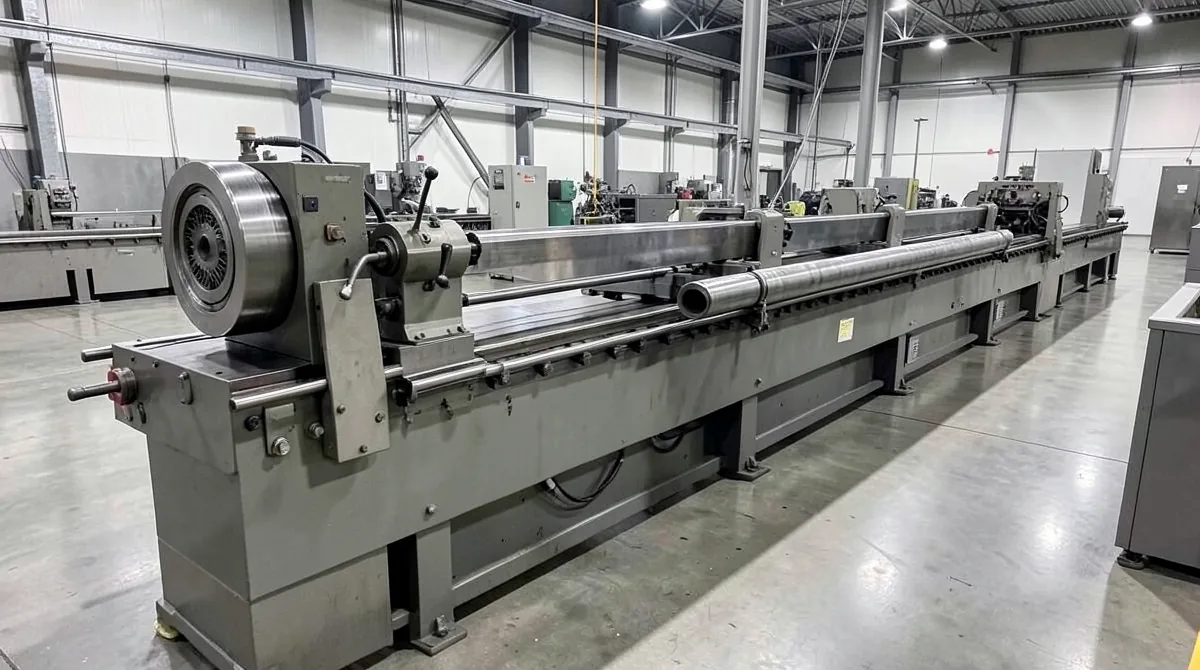
The machine fixes all of that in one operation. A tool head enters the tube, skives the inside diameter to a controlled size, and a burnishing head following directly behind it rolls that freshly cut surface to its final finish. The head travels the length of the tube once, then retracts.
The result is a bore held to size, rounder and straighter than the incoming tube, with a surface the seal can run against. Because both cutting and finishing happen on a single forward pass, the tube is handled once rather than repeatedly loaded, indexed, and measured between operations.
Skiving and Burnishing Are Two Different Operations
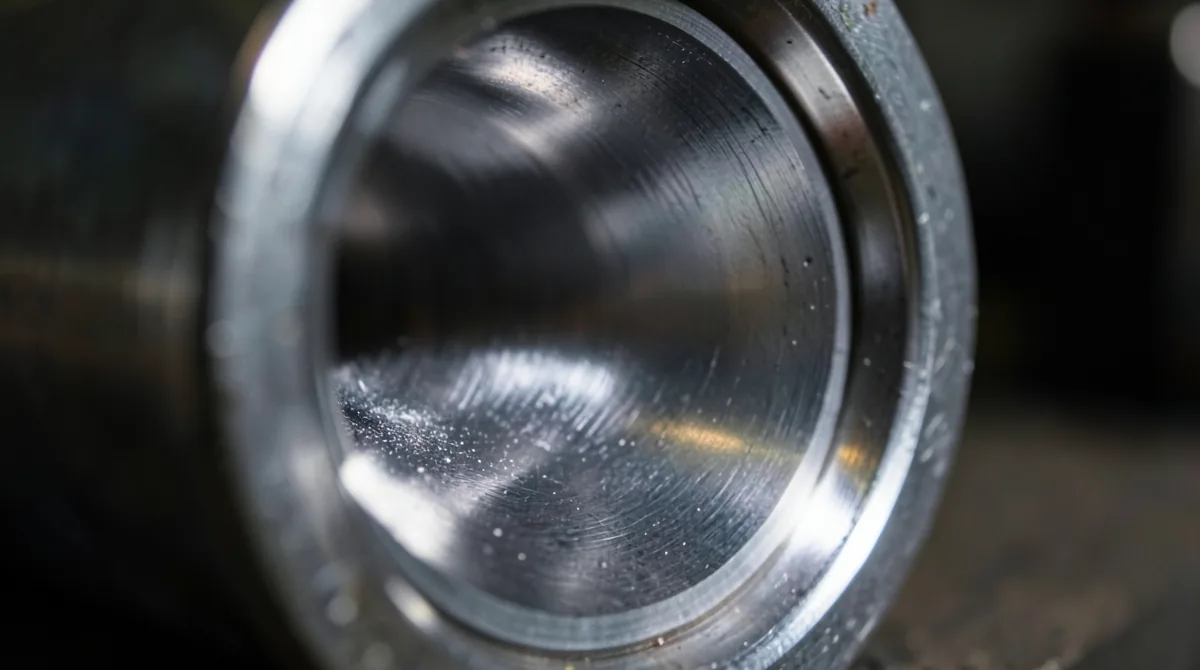
Buyers new to the process often treat the two words as one thing. They are not, and understanding the difference explains most of what the machine does.
Skiving removes material. A cutting head with adjustable blades cuts the irregular inner surface of the tube away, bringing the bore to a controlled diameter and cleaning up ovality and surface defects inherited from the mill. This is a conventional metal-cutting operation performed on the inside of a long tube.
Roller burnishing moves material rather than removing it. Hardened rollers press against the freshly skived surface with enough force to plastically deform the peaks left by the cutting tool down into the valleys between them. Nothing is cut away. The surface is flattened and compressed.
That distinction has consequences. Because burnishing works by cold deformation, it leaves the surface layer work-hardened and in compression, which is a different condition than an abraded surface of the same measured roughness. The full mechanics of the skiving and burnishing cycle are worth understanding before comparing machines, because they explain why a single pass is possible at all.
Why Hydraulic Cylinder Bores Have Specific Requirements
A piston seal is a wear part running against the bore under pressure, sometimes for millions of cycles. Three properties of the bore govern how that relationship goes.
Surface finish controls friction and seal wear. Too rough and the seal abrades quickly. Too smooth and the surface may not hold enough lubricant film, which produces its own wear pattern.
Roundness and straightness control sealing across the stroke. A bore that drifts out of round forces the seal to work harder in some positions than others, and a bore that is not straight over its length loads the seal unevenly at the extremes of travel.
Diameter consistency controls fit. A bore that changes size along its length means the seal compression changes as the piston travels.
All three come out of the same operation, which is why bore finishing carries more weight in cylinder manufacturing than its share of the cycle time suggests.
How the Surface Is Specified and Measured
Surface finish is not a matter of opinion. It is specified on the drawing and measured against a published standard.
In the United States, that standard is ASME B46.1, currently in its 2019 edition, reaffirmed in 2026. It defines surface texture and its three constituents of roughness, waviness, and lay, along with the parameters used to specify them on a drawing. The standard explicitly covers surfaces produced by plastic deformation, which is the category roller burnishing falls into, as well as surfaces produced by cutting and abrading.
That matters for anyone comparing finishing processes. Roughness average, usually written Ra, is the parameter most cylinder drawings call out, and it is a single averaged number. Two surfaces can share an Ra value and behave differently under a seal, because Ra says nothing about whether the profile is made of sharp peaks or flattened plateaus. A burnished surface and an abraded surface at the same Ra are not the same surface.
Buyers evaluating bore finishing should look at what the drawing actually requires and which parameters the receiving inspection measures, rather than treating one averaged figure as the whole specification.
Machine Size and Tube Length
The first hard constraint on any skiving roller burnishing machine is how long a tube it can accept. Machine capacity is described by working length, and the range across the market is wide.
Sierra builds machines from 1M to 11M. An 11 meter machine is a different piece of capital equipment from a 1 meter machine in floor space, foundation, handling, and price, so the length decision usually comes first in a purchase.
The question is not what you run today. Machine life in this category is measured in decades, so the useful question is what the longest tube you might reasonably run in the next fifteen years looks like. Buying short is difficult to undo, because tube length is not a capability that can be added later.
Floor layout matters as much as the machine. A machine handling long tube needs clear run-out space at both ends, and that space has to exist before the machine arrives.
Tooling Range and Material Removal
Bore range is the second constraint. A machine is only useful across the bore diameters its tooling covers.
Sierra’s tooling runs over 200 sizes from 35mm to 508mm, designed and produced in house, and removes material from 0.016 inches to 0.60 inches in a single pass. That removal range is worth reading carefully, because it sets how rough an incoming tube the process can accept. A wide removal range means more tolerance for mill variation and less pre-machining.
Single-pass removal capability is the specification that separates machines in practice. If the tube needs more stock removed than the tooling can take in one pass, the economics change, because the tube goes through more than once and the advantage of single-pass finishing disappears.
Tooling is also a consumable. Rollers and blades wear, and the cost per finished tube includes replacing them on a schedule. A machine with narrow tooling availability can be running correctly and still be down waiting on parts.
Cycle Time and What It Depends On
Cycle time is the specification buyers ask about first and the one most often quoted without its conditions.
A cycle time means nothing on its own. It is a function of bore diameter, tube length, material, stock removal, feed rate, and retract speed. Quoting a number without those variables is quoting a headline.
Sierra publishes the full condition set: one forward pass, 17 seconds, on an 80mm ID tube at 1 meter in length with 2mm of stock removal, at a feed rate up to 4 m/min and a retract speed of 9 m/min. Read those together and the arithmetic is visible. The forward pass does the work at feed rate, the head returns at a much higher retract speed, and the total is the sum of both plus load and unload.
When comparing machines, ask every supplier for the same four variables alongside any cycle figure. A number quoted on a short tube at a large bore with light stock removal is not comparable to a number quoted on a long tube at a small bore with heavy removal. The specifications behind these figures are where a real comparison gets made.
How Skiving and Burnishing Compares to Other Bore Finishing Methods
Cylinder manufacturers have more than one way to finish a bore, and the right answer depends on volume, tube size, and the finish the drawing calls for.
Honing uses abrasive stones expanded against the bore, removing material in multiple passes and producing a characteristic cross-hatch pattern. It is capable of holding tight tolerances and is well suited to work where the cross-hatch itself is specified for oil retention.
Boring cuts the bore to size with a single-point or multi-point tool. It brings the bore to diameter accurately, and it leaves a cut surface that generally needs a separate finishing operation before a seal runs on it.
Skiving and roller burnishing combines the cutting and the finishing into one pass, which is where its cycle time advantage comes from.
The trade-offs are real in both directions, and the comparison between these methods deserves more than a sentence. What is worth saying here is that the choice is driven by production volume and drawing requirements rather than by which process is better in the abstract.
What Separates One Skiving Roller Burnishing Machine From Another
Once length and bore range are settled, the remaining evaluation is narrower than most buyers expect.
Tooling source. A machine builder that designs and produces its own tooling controls the match between the machine and what goes in it. A builder that buys tooling from a third party does not.
Support reach. These machines run on production floors around the world. What matters is whether a problem gets diagnosed quickly, which increasingly means remote access to the machine control rather than a plane ticket.
Machine control. Feed rate, retract speed, and pass behavior are functions of the control, and control logic developed by the builder is easier to diagnose than a generic package.
Certification for your market. CE certification is required for machines deployed into Europe. Confirm it exists before the purchase order, not after.
Installed base and age. Ask how long the oldest machine still in service has been running, and whether the builder can point to it. Sierra has a machine sold in 1992 that is still running on a customer’s production floor, and what that machine shows about service life is more useful than a warranty period.
Total Cost of Ownership
Purchase price is the smallest interesting number in a capital equipment decision with a thirty year horizon.
The costs that accumulate are tooling consumption per finished tube, labor per tube, scrap and rework from bores that miss specification, downtime waiting on parts or support, and floor space. Against those, a machine that costs more and runs longer between tooling changes can be the cheaper machine within a few years.
Machine life is the variable buyers discount most heavily and should not. A machine still producing saleable parts after three decades has amortized itself many times over, and the difference between a fifteen year machine and a thirty year machine is larger than any price difference at the point of sale.
Frequently Asked Questions About Skiving and Roller Burnishing Machines
01What is a skiving roller burnishing machine?
It is a machine that finishes the inside diameter of a tube in one operation. A skiving head cuts the bore to a controlled size, and a roller burnishing head following behind it cold-works that surface smooth. Hydraulic cylinder manufacturers use it to prepare cylinder tube for piston seals.
02How long does it take to finish a hydraulic cylinder bore?
Cycle time depends on bore diameter, tube length, material, and stock removal. Sierra Machinery & Engineering publishes one forward pass at 17 seconds on an 80mm ID tube one meter in length with 2mm stock removal. Compare cycle figures against the same bore size, length, and removal conditions.
03What bore diameters can a skiving and roller burnishing machine handle?
Bore range is set by available tooling rather than by the machine frame. Sierra Machinery & Engineering produces over 200 tooling sizes covering 35mm to 508mm, designed and built in house in Sparks, Nevada. Confirm tooling coverage for your bore sizes before evaluating any machine.
04How much material can be removed in a single pass?
Single-pass removal capability varies by machine and tooling. Sierra’s tooling removes from 0.016 inches to 0.60 inches of material in one pass. A wider removal range accepts more variation in incoming tube, which reduces the need for a separate pre-machining operation.
05What machine length do I need?
Working length must cover the longest tube you expect to run, and it cannot be extended later. Sierra builds machines from 1M to 11M. Choose against a fifteen year production forecast rather than current work, and confirm floor space for run-out at both ends of the machine.
Sierra Machinery & Engineering: Machines and Parts from Sparks, Nevada
Sierra Machinery & Engineering has built skiving and roller burnishing machines in Sparks, Nevada for 47 years as of 2026. A 26-person team runs a 22,000 square foot shop, with every part verified in our CMM Lab before it ships.
What We Build:
- Skiving & Roller Burnishing Machines: One forward pass, 17 seconds, on an 80mm ID tube at 1 meter with 2mm stock removal. CE certified.
- Sierra Machinery Tooling: Over 200 sizes from 35mm to 508mm, designed and produced in house
Have a bore finishing problem? Request a quote and tell us the tube size, length, and material.
Works Cited
- American Society of Mechanical Engineers. “B46.1 Surface Texture (Surface Roughness, Waviness, and Lay).” ASME, 2019, reaffirmed 2026, www.asme.org/codes-standards/find-codes-standards/b46-1-surface-texture.