Every hydraulic cylinder depends on one surface almost nobody ever sees: the inside wall of the tube. If that bore is rough, out-of-round, or inconsistent from one end to the other, the piston seal wears prematurely, the cylinder leaks, and the machine it powers loses force and precision. Two manufacturing processes — skiving and roller burnishing — are what transform a rough steel tube into a round, mirror-smooth bore ready to hold pressure for years. They’re usually performed back-to-back, often on the same tool, and together they define how modern hydraulic cylinder tubes are finished. Understanding how each works explains why the pairing became the production standard.
Skiving: cutting the bore round and to size
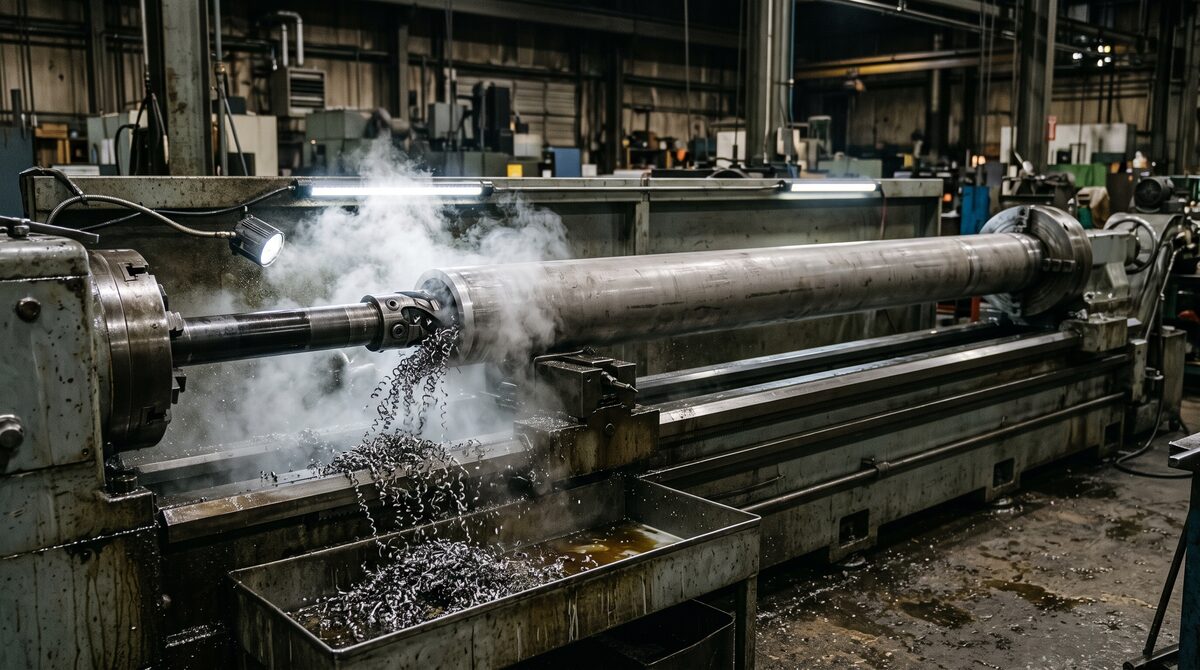
Skiving is a cutting operation, and it does the heavy geometric work. A tool carrying carbide blades arranged around its diameter is driven through the tube, and those blades slice thin chips from the inner wall as the tool advances. The result is a bore brought to a precise diameter and made geometrically round along its length. This matters because raw drawn or welded tube is seldom round or accurately sized on the inside — its interior can be oval, tapered, or scaled. Skiving corrects that, establishing the true diameter and tolerance the finished cylinder requires. Everything that follows depends on this step being right: a burnished surface is only as round as the skived bore beneath it. In effect, skiving sets the shape and removes the bulk of the material that has to come out of the bore.
Roller burnishing: pressing the surface to a mirror
Roller burnishing is a completely different mechanism — it doesn’t cut at all. It’s a cold-working process, and according to the reference definition of the technique, roller burnishing uses hardened rollers to displace material rather than remove it. Hardened rollers press against the freshly skived surface, flattening the microscopic peaks left by the blades and pushing that material down into the valleys. No chips are produced; the surface is reshaped rather than sliced. The outcome is a very smooth, highly consistent finish — the same source notes a finish below Ra 0.1 micrometer is achievable — with a valuable side effect: the surface is left work-hardened. For a hydraulic cylinder bore, that combination is close to ideal. A smoother wall reduces friction on the piston seal and helps it hold a lubricating film, while the hardened surface better resists the wear that seals and contaminants inflict over hundreds of thousands of cycles. This is why skive-burnishing is a standard route for producing hydraulic cylinder tubing.
Why doing both in one pass matters
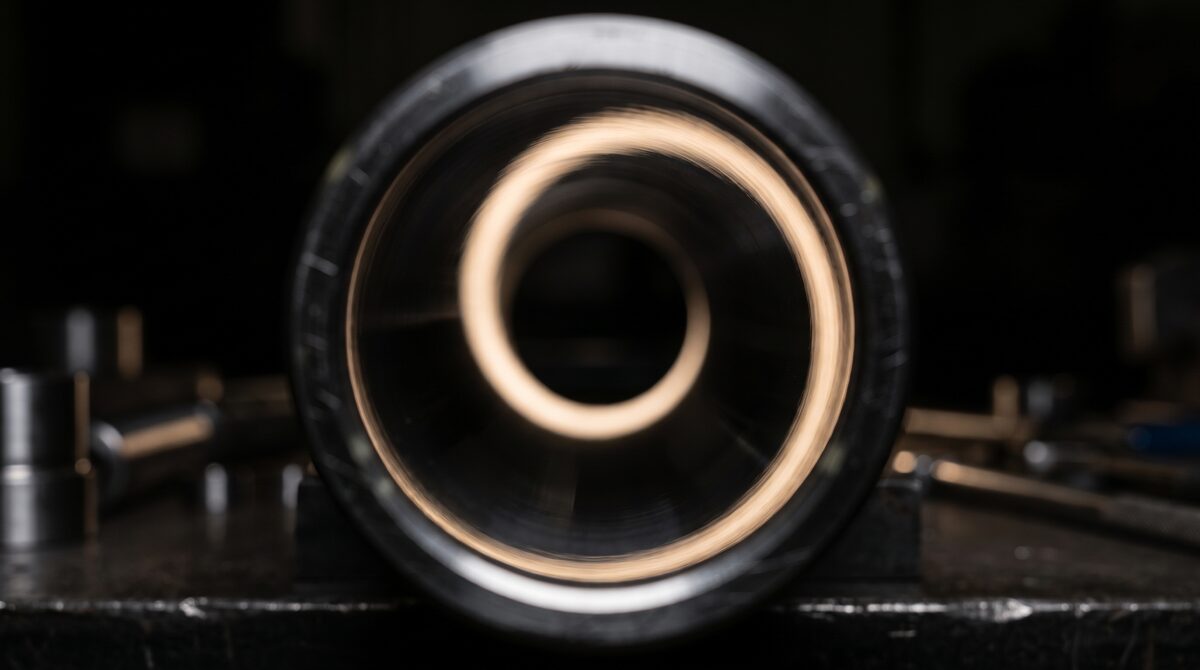
Because the two operations complement each other so neatly, they’re frequently combined on a single tool: skiving blades lead, burnishing rollers follow immediately behind, and the bore is cut and finished in one forward pass through the tube. In deep-hole work — and hydraulic tubes can be very long — this single-pass approach is a major advantage, since it eliminates a second setup and a second trip through the part. It also demands a rigid, powerful, precisely controlled machine, because both cutting and cold-working forces are applied at once, deep inside a long tube, while roundness and finish are held constant end to end. Speed and consistency on the bore feed directly into cylinder quality and cost — a link explored further in how the inside of a hydraulic cylinder decides how long it lasts.
The Sierra Machinery machine
Sierra Machinery & Engineering designs and builds both its skiving and roller burnishing machine and its patented tooling in the United States, engineered specifically to finish the inside diameter of a hydraulic cylinder in the least time possible. Per the company’s published specifications, the machine reaches a maximum feed rate of 4 meters per minute (102 inches) and a retract speed of 112 meters per minute (300 inches). As a concrete example, an 80 mm (3.15″) inside-diameter tube one meter long, with 2 mm of stock removal, can be skived and roller burnished in one forward pass in 17 seconds.
The platform is built for range as much as speed. More than 200 tooling sizes are available, spanning 38 mm (1.38″) to 508 mm (20″), and machines can be ordered to process tubes from one meter up to eleven meters, with a minimum part length of 150 mm (6″) on every machine. The control logic is developed entirely in house — the same logic the company credits for its speed — and every machine is CE certified for international deployment.
Built and supported in the USA
That domestic design-and-build approach carries through to how the machines are supported. Every new Sierra Machinery machine ships with a 12-month warranty, and the team can diagnose and resolve issues remotely, in real time, from Sparks, Nevada. Operator safety is built into each cycle through light curtain technology. The track record behind the equipment is concrete: a 90% client retention rate across 47 years, and zero lost-time incidents since 2012.
Skived-and-burnished cylinder tubes end up inside the equipment that moves the physical world — a reality detailed in the hydraulic cylinders behind farming, mining, and industrial equipment. Wherever a hydraulic cylinder must seal reliably under load, the quality of that bore finish is doing quiet, essential work — and Sierra Machinery has built the equipment that produces it, from its Sparks, Nevada shop, since 1979.
Frequently Asked Questions
01What is the difference between skiving and roller burnishing?
Skiving is a cutting process: carbide blades slice thin chips from the inside of the tube to make the bore round and bring it to size. Roller burnishing is a cold-working process: hardened rollers press down the peaks left by skiving to smooth the surface. In short, skiving removes material while burnishing displaces it.
02Why are skiving and roller burnishing used on hydraulic cylinders?
A hydraulic cylinder bore has to be round and smooth so the piston seal can ride against it without leaking. Skiving establishes the round, correctly sized bore, and roller burnishing produces the smooth, slightly hardened finish — which is why skive-burnishing is a standard route for hydraulic cylinder tubing.
03Can skiving and roller burnishing be done in one pass?
Yes. The two operations are frequently combined on a single tool, with the skiving blades leading and the burnishing rollers following directly behind, finishing the bore in one forward pass through the tube.
04How fast is Sierra’s skiving and roller burnishing machine?
Per Sierra’s published specifications, the machine reaches a maximum feed rate of 4 meters per minute (102 inches) and a retract speed of 112 meters per minute (300 inches). As an example, an 80 mm inside-diameter tube one meter long with 2 mm of stock removal can be skived and roller burnished in one pass in 17 seconds.
05What size tubes can Sierra’s machine process?
More than 200 tooling sizes are available, ranging from 38 mm (1.38″) to 508 mm (20″). Machines can be ordered to process tubes from one meter up to eleven meters, with a minimum part length of 150 mm (6″) on every machine.
Sierra Machinery & Engineering: The World’s Fastest Skiving & Roller Burnishing Machine
Sierra Machinery & Engineering designs and builds its skiving and roller burnishing machine and patented tooling in the United States, purpose-built to finish hydraulic cylinder bores in minimum time.
Explore Our SRB Products:
- Skiving & Roller Burnishing Machines — The world’s fastest skiving and roller burnishing machine, built in Sparks, Nevada
- Sierra Machinery Tooling — Patented tooling in over 200 sizes from 35 mm to 508 mm
Ready to see it run? Contact Sierra Machinery to submit an RFQ and hear from the people actually running the shop.
Works Cited
- “Roller Burnishing.” Wikipedia, Wikimedia Foundation, en.wikipedia.org/wiki/Roller_burnishing. Accessed 29 July 2026.