The political conversation about American manufacturing in 2026 is almost entirely about where the work goes: which tariffs push production home, which incentives lure factories back, which supply chains get shortened. It’s the wrong thing to obsess over. The machines can be bought, shipped, and installed. The plants can be built. What no policy can conjure on the same timeline is the person standing at the control panel who knows how to turn a drawing into a finished part. Heading deeper into 2026, that person — the skilled machinist — is the scarcest input in the entire reshoring equation, and the shortage is quietly deciding which reshored production actually happens and which stays a press release.
This is not a soft problem or a talking point. It is a measurable, demographic, and increasingly urgent constraint that touches every precision shop, every OEM trying to localize, and every buyer who assumes domestic capacity can simply scale up on demand. The reshoring wave is real. The workforce to absorb it is not keeping pace.
The demographic math no one can automate away
The core of the shortage is generational. The machinists who built their careers in the 1980s and 1990s — the ones who can read a print, dial in a setup by feel, and troubleshoot a bad finish without a manual — are retiring in large numbers, and the pipeline behind them was never rebuilt to match. For two decades, manufacturing was culturally coded as a declining field, high schools steered students toward four-year degrees, and shop classes disappeared from curricula. The result is a workforce with a thick top and a thin bottom: experienced hands leaving faster than trained newcomers arrive.
That imbalance is the reason the labor gap persists even in an era of automation. Robots and CNC controls have absolutely changed the shop floor, letting one skilled operator do what several used to. But automation raises the skill floor rather than eliminating it. A modern machining cell still needs someone who can program it, prove out the first article, catch the drift before it scraps a run of parts, and fix the problem when the automation does exactly what it was told instead of what was intended. Those are not entry-level tasks, and they are precisely the skills in shortest supply.
What the government data actually shows
The federal numbers make the squeeze concrete. According to the U.S. Bureau of Labor Statistics, machinists held about 299,500 jobs in 2024, with roughly 34,200 openings for machinists and tool and die makers projected each year on average across the decade. The detail that matters is where those openings come from. Overall employment in the occupation is actually projected to decline slightly — about two percent through 2034 — as CNC tools, autoloaders, and high-speed machining make each worker more productive. And yet tens of thousands of openings appear every single year regardless.
The reason is replacement, not growth. Essentially all of those annual openings exist because workers are leaving the occupation — retiring, or moving on — and someone has to backfill them. In other words, even in a field where headcount is technically shrinking, the demand for new trained machinists is relentless simply because the existing workforce is aging out. The median machinist earned $56,150 in 2024, and tool and die makers more, so this is not a low-wage dead end; it is skilled, well-compensated work with a chronic staffing hole underneath it. Fabricated metal product manufacturing — the exact kind of multi-process shop work at the heart of the reshoring story — is the single largest employer of these workers, which means the shortage lands hardest on the shops the reshoring push depends on.
Reshoring’s hidden dependency
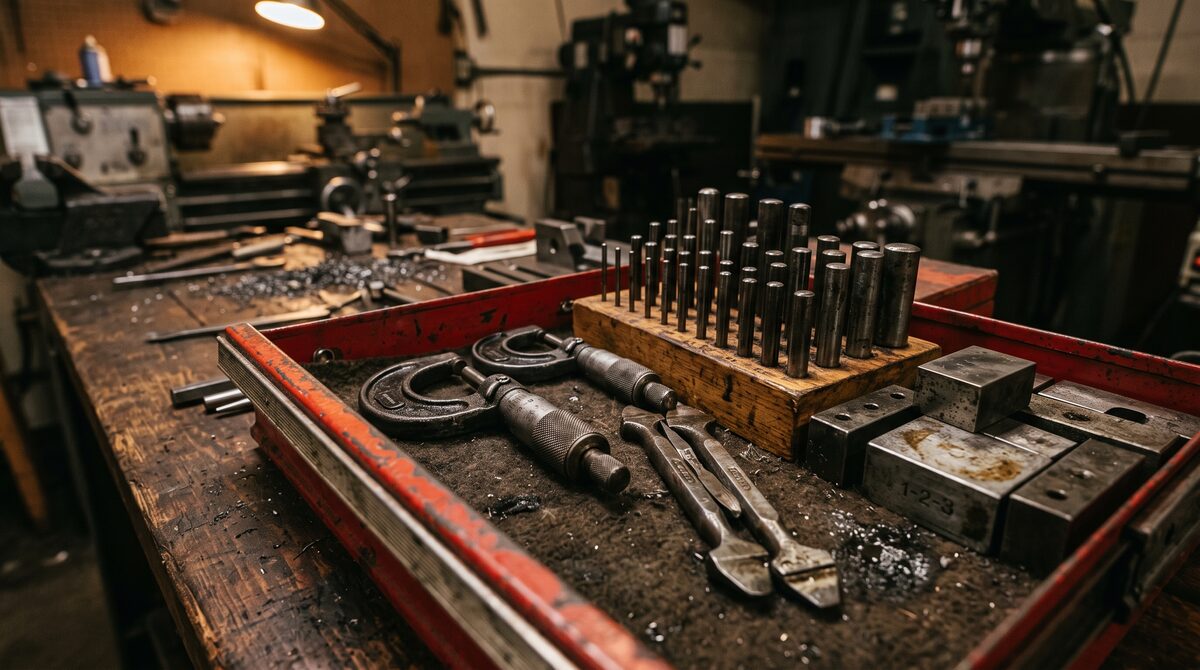
Here is where the workforce story collides with the trade story. The macro case for bringing production home — tariffs, supply-chain resilience, proximity to customers — is laid out in Tariffs and Reshoring Are Rewriting the Math for U.S. Precision Machining in 2026. But every one of those arguments assumes the domestic capacity exists to catch the work. Reshoring is not a switch; it is a bet that American shops can staff up, hold tolerance, and deliver at volume. When the skilled-labor pool is this thin, that bet gets harder to make.
Manufacturers themselves say as much. In survey after survey, industry leaders rank the availability of skilled workers as a more powerful driver of reshoring decisions than tariffs, tax rates, or a weaker dollar. Companies have stated plainly that they would bring more production back if the trained workforce existed to run it — and that the workforce, not the trade policy, is the binding constraint. That is a remarkable admission. It means the single most effective lever for reindustrializing America is not another duty on imported steel; it is a machinist who can hit a tolerance. Policy can create demand for domestic parts. Only the workforce can supply it.
A gap measured in the millions
Zoom out from machinists specifically to manufacturing as a whole, and the scale becomes daunting. The 2024 Deloitte and Manufacturing Institute talent study projects a net need of roughly 3.8 million manufacturing workers between 2024 and 2033, with about 1.9 million of those jobs at risk of going unfilled if the skills gap and the applicant gap are not closed. Roughly half of the openings the industry expects to generate could simply go empty — not because the jobs don’t exist, but because there aren’t enough qualified, interested people to take them.
The study also flags a compounding pressure that rarely gets attention: competition from adjacent trades. The same policy incentives fueling factory construction are driving enormous demand for welders, electricians, and other skilled tradespeople to build those facilities. That construction boom pulls from the same limited pool of hands-on talent manufacturers are trying to hire, intensifying an already tight market. The people who can wire a panel or weld a frame have more options than ever, and manufacturing is now competing for them against construction, energy, and infrastructure projects all at once.
Why “just automate” doesn’t solve it
The reflexive answer to any labor shortage is automation, and the industry is investing heavily in it. But automation is a force multiplier for skilled workers, not a substitute for them. Lights-out machining, robotic tending, and pallet systems all let a shop produce more with fewer people — provided those few people are highly capable. The technology shifts the bottleneck upstream, from “we need more hands on the machines” to “we need more people who can program, set up, and babysit sophisticated automated cells.” That second problem is harder, because those workers take longer to train and are in even shorter supply.
The shops navigating this best aren’t the ones with the most robots. They’re the ones that have retained deep experience and cross-trained their people so that one skilled worker can move fluidly across processes — turning, milling, EDM, grinding — instead of being locked into a single operation. In a thin labor market, versatility is leverage. A machinist who can run four processes is worth several who can each run only one, because the constraint isn’t machine time; it’s skilled human judgment.
Experience is the truly scarce resource
Ultimately, the shortage is not just about counting bodies. It’s about the tacit knowledge that only accumulates over years on a shop floor. A veteran machinist hears a spindle loading up and knows something’s wrong before a sensor flags it. They feel when a finish is off, read a tricky print without second-guessing the datums, and know which setup will hold and which will chatter. None of that transfers through a two-week onboarding. It is built, slowly, and when an experienced machinist retires, that knowledge walks out the door unless it was deliberately passed on.
That is why the shortage bites hardest in demanding, component-heavy work where tolerances are unforgiving and mistakes are expensive. Hydraulics is a prime example — a sector where the parts are steel-intensive, the tolerances tight, and the cost of getting it wrong high, as detailed in Tariffs on Imported Cylinder Components Are Pushing Hydraulic Manufacturing Back Onshore. In fields like that, a shop’s roster of experienced hands isn’t a line on a résumé; it’s the difference between quoting the job with confidence and turning it away.
The cost of a thin bench
For buyers, all of this reshapes what a good supplier looks like in 2026. Price per part still matters, but so does whether the shop can actually deliver — whether it has the experienced people to run the job, hold the tolerance, and do it again next quarter without the knowledge evaporating in a retirement. A shop with a stable, deep, cross-trained team is, in this market, a form of supply-chain insurance. The reshoring trend may bring the work home, but it lands only where the skill exists to catch it.
Where Sierra Machinery fits
This is precisely the environment in which a shop’s accumulated experience becomes its competitive edge. Sierra Machinery & Engineering has operated in Sparks, Nevada since 1979, and its bench reflects exactly the kind of retained expertise the shortage makes rare: a plant manager with 30 years in manufacturing, a quality supervisor with 15 years in the field, and a machine building supervisor who is a certified welder with 14 years of hands-on fabrication experience. This is not a team learning on the job — it’s the depth that took decades to build.
That experience spans lathe, mill, Wire EDM, and grinding under one roof, backed by a dedicated CMM lab that verifies parts to tolerance before they ship. In a market where skilled hands are the real bottleneck, that combination of retained knowledge and multi-process capability is the asset that keeps parts moving when a thin labor pool is slowing everyone else down.
Sierra Machinery & Engineering: Precision Manufacturing Under One Roof
Sierra Machinery & Engineering delivers CNC machining, lathe, mill, Wire EDM, and grinding for hydraulic and general industrial customers — every process in one Sparks, Nevada facility, backed by a dedicated CMM lab and a long-tenured team.
Our Capabilities Include:
- CNC Machining & Precision Manufacturing — Multi-process, tight-tolerance work across a full range of part sizes
- Wire EDM, Grinding & Multi-Process Parts — Complete in-house machining for complex, multiple-operation jobs
Have a complex part? Contact Sierra Machinery or submit an RFQ to reach the people actually running the shop.
About the Author
Stanley Wright is a seasoned executive with three decades of experience in the management of manufacturing companies. In 2018 he had the privilege to take over the management of Sierra Machinery, Inc. from Krestine Corbin, the founding owner, who had developed the company’s global reach before her retirement. Since that time, he has worked to further develop the customer focus and manufacturing excellence needed to compete and succeed in today’s world and beyond. He believes all business relations should begin with honesty and the highest ethics. Following that, clear communication is the hallmark of a successful company serving its customers well.
Works Cited
- “Machinists and Tool and Die Makers.” Occupational Outlook Handbook, U.S. Bureau of Labor Statistics, 28 Aug. 2025, www.bls.gov/ooh/production/machinists-and-tool-and-die-makers.htm. Accessed 6 July 2026.
- Coykendall, John, et al. “Taking Charge: Manufacturers Support Growth with Active Workforce Strategies.” Deloitte Insights, Deloitte and The Manufacturing Institute, 3 Apr. 2024, www.deloitte.com/us/en/insights/industry/manufacturing-industrial-products/supporting-us-manufacturing-growth-amid-workforce-challenges.html. Accessed 6 July 2026.